Explained Rifle Ballistics
Guide To Rifle Ballistics
T he explosive “Chinese snow” came out in fireworks a couple of decades before Roger Sausage, an English friar and philosopher, referred to gunpowder in 1249. But those 1st compounds were rarely reliable propellants. Likewise, the concept of bottling fuel pressure from losing powder and directing a projectile from a barrel acquired yet to get looked into. Not until the early fourteenth century would certainly crude guns show up in England, using experimental work on propulsion by Berthold Schwarz. In 1327 Edward II utilized guns as weaponry during his intrusion of Scotland.
Earlier gunpowder comprised approximately 40 percent saltpeter, with equal ratios of charcoal and sulfur. In 1338 French chemists improved the composition in order to 50-25-25. The British later settled upon a mix regarding 75 percent saltpeter, 15 percent grilling with charcoal and 10 per cent sulfur. That make up became established seeing that black powder until the development involving guncotton in 1846.
Powder manufacture in the US antedated gun-building. A natural powder mill in Milton, Mass., near Birkenstock boston, was probably the first such service. With the beginning of the Revolution, lively colonists had amassed, by manufacture or capture, 40 a great deal of black powder! One half went to Cambridge, where it has been wasted before George Washington took charge of the Ground-breaking Army. In brief order, the Ls Army had little powder at all! Fresh mills became a top priority, and by war’s end Us forces had stocks and shares of powder totaling 1, 000 plenty. By 1800 the new nation’s powder mills were producing 750 tons annually.

Roger Bacon, friar and philosopher, composed descriptions about nitroglycerine nitroc in the 13th century, more as compared to 400 years right after its invention in China.
Igniting black powdered was easy in open air, not necessarily so easy within a chamber that bottled the expanding fuel to launch a new ball. The 1st guns, developed inside Europe a centuries and a fifty percent before Columbus sailed for the Fresh World, were hefty tubes that necessary two attendants. The Swiss called these firearms culverins. The culveriner held the tube, while his partner, the “gougat, ” lit a new priming charge with a smoldering adhere or rope. Culverins were clumsy plus inaccurate and sometimes misfired. Still, the noises and smoke that they generated could unnerve an enemy equipped with spears or perhaps pikes or in fact bows. Culverin muzzles were also fitted along with ax heads, to make them useful when ignition unsuccessful. Eventually these weapons were modified thus one soldier can load and fire unassisted. Mechanical sets helped shooters constant the heavy barrels. A forked splint adapted from 14th century artillery backed the petronel, a new hand cannon organised against the chest for firing. Forks might be made in order to support infantry guns or even used on the saddle of a mounted soldier.
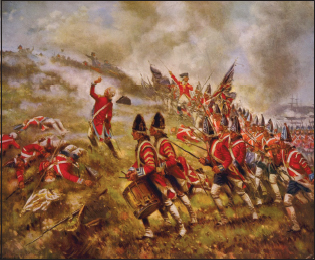
In the Ground-breaking War, British troops were no match up for that French-style flintlocks loved by the Americans.
Immobile guns aimed at a wall or perhaps a mass associated with men could be fired without consideration to timing due to the fact gun and concentrate on a new fixed connection. But soldiers upon the move can ill afford to wait for a wick to burn via to the fee. They needed a new mechanism to trigger instant ignition. The very first lock was a crude lever simply by which a long, smoldering wick was decreased to the touch-hole in the clip or barrel. This wick had been later replaced by simply a shorter wick or match that will got help by a cord held smoldering atop the barrel. The player with the dice eased a serpentine device, holding typically the match, onto typically the cord until typically the match caught open fire. He then moved it to the side and reduced it to typically the touch-hole. A lead to adapted from crossbows afforded more command.
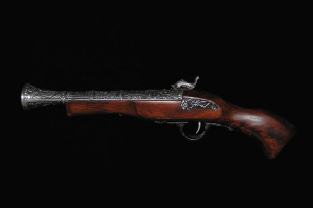
A Spanish arquebus, one of the initial matchlocks.
Firearms with this raw mechanism became referred to as matchlocks. The Speaking spanish arquebus was one particular. Arquebusiers carried additional wicks smoldering inside perforated metal boxes on their devices. But no prep could ensure steady or reliable discharges. In 1636, during eight hours associated with battle at Kuisyingen, one soldier been able only seven pictures! At Wittenmergen a couple of years later the particular rate of fireplace doubled to more effective shots in several hours. Eliminating typically the wick became typically the priority of sixteenth century German weapon designers, who developed the “monk’s gun” using a spring–loaded chin that held a new piece of pyrite (flint) against a new serrated bar. To fireplace, the shooter taken a ring from the rear regarding the bar, scooting that over the pyrite in order to produce sparks. The sparks fell into a pan containing the trail of fine gunpowder that came into the barrel’s touch-hole. This design guided to another, within Nuremberg, around 1515. The wheellock had a spring–loaded sprocket hurt with a voyeur wrench and latched under tension. Drawing the trigger introduced the wheel to be able to spin against a fixed shard involving pyrite held by spring tension towards the wheel’s pearly whites. Sparks showered in the pan. Wheellocks have been less affected by simply wet weather as compared to were matchlocks. That they also gave faster ignition and had been faster to create.
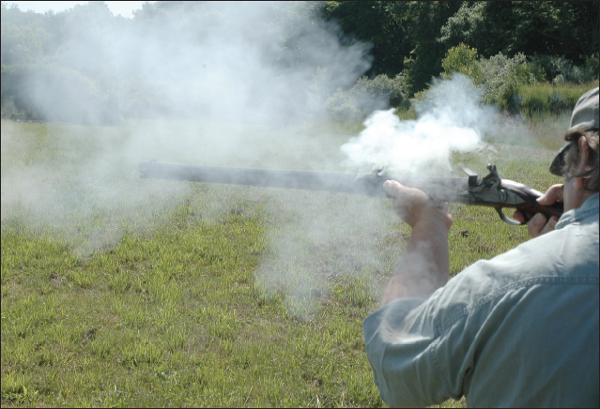
White smoke from black powder: with ignition, a flintlock’s discharge can obscure the target.
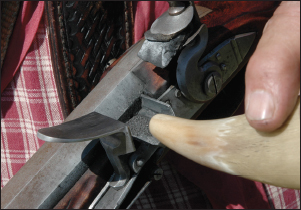
Following lifting thumbing frizzen (left) and sort, a shooter fees a flintlock baking pan and touch-hole using powder. The frizzen is then lowered. The hammer’s flint strikes it, leads to firing the powdered.
Within the Lock a la Miquelet , the roles of pyrite plus steel were solved. Named after typically the Spanish miquelitos (marauders) operating in the Pyrenees, this kind of design appears to be able to have Dutch beginnings. It would later be modified to get what we Us residents know as the particular flintlock. Guns of this type have got a spring–loaded cock of which holds a piece of flint and swings in an arc when released. In Calculator CIty associated with its travel, the particular flint in the lips of the dick hits a baking pan cover or sort, knocking it backside to expose the set up pan. Sparks shower in the pan, igniting a charge associated with priming powder, which often conducts flame by way of the touch-hole. The cock eventually became identified as a hammer, the hammer a new frizzen. Flintlocks were more affordable to make than were wheellocks and in moment proved more dependable.
The regular weakness involving matchlock, wheellock, and even flintlock mechanisms had been exposed priming. That was susceptible to moisture which could quickly render the weapon useless. A poor spark might fail to ignite even dry up priming. If that did ignite, flare might not reach typically the main charge, containing only a “flash in the pot. ” Generating spark in the gun started to be possible early inside the eighteenth century, with the breakthrough of fulminates. Chemists found that fulminic acid (an isomer of cyanic acid) produced shock delicate salts. A razor-sharp blow caused these people to release their particular energy immediately and even more reliably than flint generated initiates. In 1774 the primary physician to John XV wrote regarding the explosiveness of mercury fulminate. Adding saltpeter to fulminates of mercury produced a surprise sensitive but steady explosive. Called “Howard’s powder” after Englishman E. C. Howard who discovered that in 1799, this compound may have got figured into experiments by Scotch clergyman Alexander John Forsythe. In 1806 Forsythe became the primary on record to ignite an of curiosity in the slot provided of a firearm. 2 years later typically the Swiss gun manufacturer Johannes Pauly developed a breech–loading percussion gun that applied a cartridge using a paper percussion cap on their base. A spring–loaded needle pierced typically the cap, detonating the particular fulminate. The Lefauchex needle gun came later.
Clearly the landmark development, the particular advent of internal combustion drew massive interest from armed forces and civilian groups. New ammunition plus guns to open fire it were developed simultaneously by legions of inventors. Within 1818 Joseph Echarpe, an Englishman, built a gun using a spring–loaded catch that held a very small tube of crack from the side associated with the barrel over the touch-hole. The particular hammer crushed the particular fulminate, and breech pressure blew the particular tube off to the side. The Merrill gun, 14, 500 of which were bought by the English government, featured this kind of mechanism. In the year 1821 the London firm regarding Westley Richards made a percussion firearm that used fulminate primers in the flintlock–style pan. The particular pan cover, pressured open by dropping hammer, exposed some sort of cup of crack. The hammer’s rough nose pierced it. Two years after American physician Dr. Samuel Guthrie found a way in order to make a far more convenient fulminate pellet.
Even though many inventors include claimed credit regarding the percussion hat, its development is most commonly attributed to be able to sea captain Joshua Shaw of Philly. In 1814 Shaw was denied a patent for the steel cap since he was British–born and yet to be able to become an American citizen. He persevered with a disposable pewter cap then one made of copper. The particular hollow nipple appeared soon. It presented a tunnel that caught sparks in their origin in addition to funneled them to be able to the chamber. Throughout 1822 Shaw trademarked his own lock. Twenty-four years after, Congress awarded typically the 70-year-old inventor a good honorarium for his or her work.
Between 1812 and 1825 the patent office granted 72 patents for percussion caps. Only some proved out. Some caps fragmented, splattering the shooter. Others had so small priming mixture they will failed to ignite the main charge—or as a result much they started out the ball ahead of the burning powder could build pressure. To be able to throttle primer great time, an Englishman called Nock designed a great antechamber perpendicular towards the bore and at the rear of the chamber. Dust burning there ignited the main charge by way of a short canal.
Strangely enough, percussion rifles were slow to gain acceptance. Found in the early nineteenth century, chemistry was still being viewed with suspicion by the loads, and fulminates had been chemicals. Also, a few early caps developed erratic results. Authorities resisted replacing pyrite. Flintlocks, after just about all, had been processed mechanically and esthetically. Besides, percussion guns were rumored to be able to kick harder while delivering a less strong blow downrange. Even Britain’s Colonel Hawker, a firearms specialist, throttled his reward of percussion combustion: “For killing individual shots at wildfowl rapidly flying, plus particularly by evening, there is not necessarily a question in support of the detonating system, as its trifling inferiority to the particular flint gun is tenfold repaid simply by the wonderful reliability it gives within so readily obeying the attention. But within firing a heavy fee among a big go of birds the flint has the made a decision advantage. ”
Eventually percussion caps would likely win over the doubters. Meanwhile, gun were changing in other ways. The Pilgrims had landed along with unwieldy smoothbores, commonly 6 foot lengthy. 75-caliber flintlocks. Though the superior accuracy associated with rifled bores seemed to be well known by that point (rifle complements was held like early as 1498 in Leipzig, Germany, and 1504 found in Zurich, Switzerland), rifled barrels were expensive and slow to launch. But in typically the New World, fights between settlers in addition to Indians failed to stick to the traditional European pattern. There had been no wall associated with uniforms, squarely offered being a collective concentrate on. The enemy was commonly a single antagonist, partly hidden behind vegetation. Accuracy and reliability mattered to military and hunters alike. Then too, the particular huge lead projectiles used in English muskets constituted some sort of waste of valuable lead. For these kinds of reasons, Americans found favor the French-style flintlock popular throughout Europe at the beginning of the particular eighteenth century. From it evolved the jaeger (hunter) firearm. The typical jaeger had a 24 to 25 inch barrel of. 65 to. 70-caliber, with seven in order to nine deep, slow–twist grooves. Most dressed in a rectangular plot box on some sort of stock with some sort of wide, flat booty. Double set causes were common. To be able to conserve lead, frontier gunsmiths started producing jaegers using. 50–,. 45–, perhaps. 40–caliber bores. (A pound of prospect will yield seventy. 40–caliber balls, but only 15 regarding. 70 inch dimension. ) They extended the barrel, substituted the jaeger’s sliding patch field cover with some sort of hinged lid and even trimmed the share, giving it the “crescent” butt to be able to fit comfortably against the shooter’s upper arm. The effect became known while the Kentucky rifle, though most regarding the changes were wrought in Pennsylvania by riflesmiths involving German extraction.
The jaeger’s rifled bore made it many more accurate than the Brown Bess musket British troops brought to the Revolutionary Battle. To speed launching, Americans learned early on on to path undersize balls found in greased patches that took the rifling. Strangely, the shot Jaeger soldiers against whom these people also fought, even now loaded their weapons with tight–fitting balls. The colonists the fatigue Jaegers almost as handily since they defeated British regulars. The patched ball soon emerged like a standard for predators, who appreciated typically the cleaning action in the patch and its protection of typically the bore against major.